Monday, December 17, 2007

The Hundred Steps


The Hundred Steps is a historical film, depicting the life of Peppino Impastato, outspoken activist against the Mafia. The film is a terrific look into a significant time period in the history of Italy.


HISTORY
Researching Italian history, I am amazed to find how deeply the idea of communism is rooted in Italy. For a country so slow to industrialize, Italy has taken vast steps towards the left. It began with the Partito Socialista Italiano, PSI, or Italian Socialist Party in 1892. This party at its height was 860 thousand members strong in 1946, according to Wikipedia. This party eventually split into two separate groups: the reformists- who were strong in parliament, and the maximalists- led by Mussolini. Soon the Maximalist group overcame the reformists and ousted them from the party. Developed through leftist views came the Partito Comunista Italiano, PCI, or Italian Communist party, a group that reached higher prevalence than the socialist group with over 2 million members in 1947. The group was once led by Antonio Bordiga and Antonio Gramsci as they increased the rift between their party and the socialists.


TERRORISM
The Red Brigades was a terrorist group active during the “Years of Lead” or highly turbulent time of political instability. There were many politically-motivated murders, one being the killing of Aldo Moro, who was assassinated during this time. Moro, a Christian Democrat, was trying to make compromises with the Communist party, led by Enrico Berlinguer, an agreement known as the compromesso storico, or historic compromise. In an extremist response, the Red Brigades kidnapped Moro and after 54 days of captivity, assassinated him. The terrorist group left the body in the trunk of the car half way between the Christian Democratic office and Communist offices in a symbolic gesture. Today there are also many different conspiracy theories concerning the death of Moro.


The actions of the Red Brigade show some significant resemblance to the FLQ, or Front de libération du Québec (Quebec Liberation Front). The FLQ was another terrorist group that used extreme means instead of peaceful endeavors. Like the Red Brigades, the FLQ was comprised of Marxist followers who wanted to declare war on their Anglophone oppressors, overthrow Quebec government, and separate from Canada. The group was active from the years 1963-1970, and was responsible for over 200 bombings and the death of five people. Two separate FLQ cells kidnapped two political figures, one after the other. First it was English-speaking James Cross, British Trade Commissioner, and than Pierre Laporte, Quebec’s own Minister of Labour. Laporte was soon killed (some reports suggest it was an accident). In order for Cross to be released they made several demands, including transportation to Cuba. Some of them were met and after two months, and Cross was finally let go. This period was known as the October Crisis.

This terror organization seemed to operate much like the Red Brigades, or least performed some acts that are closely similar. These actions took place less than a decade before, and proved to be successful on some account. The actions of this group could have likely inspired the Red Brigade’s kidnapping of Aldo Moro.


CINEMA

Color. The mise-en-scene in the film is very detailed. The use of the color red is abundant throughout the movie. For instance in the scene where the young Peppino is at his Uncle’s funeral, his small frame is surrounded (?) by an extravagant red thrown like chaird looking like the king of Communism (if there could be one). Also in the scene after his father first learns of his dealings with Communism, there is a red light covering him while he is lying on the bed, showing that this ideal of Communism was soon to encompass his life.

Music. There was also a significant amount of American music used in the film. In fact in scenes that show Peppino in progress, mostly have an American soundtrack in the background. I found this extremely peculiar, since for most American, the ideal of communism is taboo. II Iasldkfjfjdkls;a jlkewr Although the soundtrack featured artists synonymous with the anti-war, leftist view, like Janis Joplin and Lenard Cohen. I was also surprised to see how the hippie culture was vastly apparent in Italy during that time.

STORY
The story is one that is bittersweet. The reality of it even seems to contain dramatic, narrative elements. The way in which Peppino was killed mirrored the same way that his Uncle, whom he had a positive relationship with, was killed. There is also the probability they along with Peppino’s father were set up to be killed by the same person, Don Tano. Tano, who lived just one hundred steps away, was an interesting figure. In the 80’s he came to the U.S. and sold drugs out of pizza parlor. He was convicted in 1987 for drug trafficking and then later in 2002, was convicted of the death of Peppino Impastato. Tano died in prison. His drug empire was estimated at $1.65 billion.

A complex version of Tano exists in the film. In the scene where he visits Peppino at the coffee house we see a side to Tano that we have not previously encountered. You see the struggle inside of Peppino as Tano explains what he has done for his family. In a sense, Tano helping Peppino’s father, actually helped Peppino become what he was. Peppino’s family wasn’t suffering from financial peril and this allowed him and his brother to attend school. Is the scene in the pizza parlor a dream sequence, or did Tano really offer an escape path to Peppino?

It is very ironic that the Impastato business was a pizza parlor, which was also the means that Tano used to sell drugs in the states.
http://news.bbc.co.uk/1/hi/world/americas/3675535.stm


http://www.youtube.com/watch?v=xnDEcQm5lEE&feature=related


http://www.youtube.com/watch?v=Gq7ekpUjrMs&feature=related

Thursday, December 13, 2007

L'America

"While he has not made a documentary, his film reflects a heightened sense of reality derived from the experience of life." --- Rob Edelman

“L’america” was directed by Gianni Amelio (the man responsible for a film we watched earlier in the semester, “The Keys to the House”) and released in 1994. What is unique about this film is that it brings traditional linear Italian film-making to new places by using the methods of neo-realism to carry the audience along on a dreamlike, ironic mythologizing journey whose mood and methods are all his own. This extremely powerful film, almost documentary-like in its presentation of its characters and themes, is as fantastic as it is vividly concrete and sad.

The film tells the story of two Italians, Fiore (Michele Placido) and his assistant Gino (Enrico Lo Verso) who go to the impoverished, wrecked post-communist Albania with the scam of setting up a shell shoe factory as what they - or Fiore, for the most part, because he by himself is the mastermind of the scam - think will be a profitable tax shelter. They corrupt an Albanian official named Kruja, which they turn into Croce (cross) to grease the bureaucratic wheels and obtain government approval for the plan. Unsatisfied with others who have cooperating families who are able to make claims, they find Spiro (Carmelo Di Mazzarelli), an old man they are told is an orphan and has been imprisoned by the communists for fifty years. They sign him up as the Albanian figurehead "president" of the company. Fiore hurries back to Italy and leaves Gino in charge of watching over the derelict factory they have taken control of, and also to make sure Spiro stays out of trouble.

When Fiore leaves however, things go wrong, and as the story progresses, they get even worse, until Gino has lost everything - even his Italian identity. The journey we as the viewers go on is compulsive watching and echoes tragic wanderings like those of the father and son in De Sica's “The Bicycle Thief”, or the couple in Fellini's “La Strada.” Amelio achieves a sense of understanding and a sorrow and pity that a person can have only when everything has been stripped away from them and nothing but their essential humanity remains. Basically, you have to imagine the worst thing that could happen to you while on a journey, and then take that even further, and you have an idea of the trajectory and transformative emotional power of “L’america.”

When Gino finally gets ahold of Fiore on the phone, he learns that their scam has failed, and they are not only in deep trouble, but he and Spiro are both out of a job. Of course, Spiro says he knew this would happen all along. The Spiro character is extremely pivotal in the film. At first he appears as a derelict, worse than a bum, clearly out of his mind. When asked his age he holds up his fingers twice, and the viewer realizes he still thinks he’s twenty years old. But somehow there is a young man still inside Spiro that seems to emerge as the film goes along as a figure of great humanity, energy and hope.

The first disaster occurs when Spiro disappears from the nuns' institution where they have left him. After being a prisoner for fifty years, all he wants to do now is escape. Gino finds him and takes him on a journey along the coast in a jeep, but once they're out in the middle of nowhere, Gino is lost. He runs around frantically looking for Spiro, and when he gets back to the car, it has been stripped of its tires. He calls for the police, but since he only speaks Italian, no one can understand him. They can only stare at him. These faces Amelio shows us, and again at the end, in that powerful closing montage on the boat heading for Italy at long last, communicate more with these pained and tired expressions than any words ever could.

Much like the great Italian neo-realist filmmakers of the forties and fifties, Amelio uses real places and real people with great skill. What does all this mean? First of all, it's an affirmation of the sheer and inexplicable power of poverty. The fact that Spiro's insanity comes across as beautiful and hopeful shows that the film is not to be taken too literally. The film shows us a lot about Albania, colonialism, rich and poor nations and economic exploitation, yet at its core it is truly a film of heart-wrenching sadness. When we see those faces in the closing scene, the pain felt by these people is truly individualized, showing us the viewers that the problems highlighted not only in this film but in other issues plaguing the world today can be seen in one agonizing stare.

“L’america” is a breathtaking film, and clearly sets Amelio apart as one of the most powerful and humanistic Italian filmmakers working today.

Source:

http://www.filmreference.com/Films-A-An/L-America.html

Wednesday, December 12, 2007

I Cento Passi

I Cento Passi

“I want to give up politics and life” – Giuseppe “Peppino” Impastato

This was the sentence that allowed the city officials in Cinisi to pass off Peppino’s death as a suicide. In reality the mafia dealt him out a fate he and his supporters probably could have seen coming, considering he spent the most important years of his life mocking them and their ill power.
The film I Cento Passi directed by Marco Tullio Giordana serves to recount the tale of Peppino’s life from his childhood to his unfortunate death and even beyond, to show his numerous supporters. This fast-paced film brings out Peppino as a people’s hero, sacrificing his safety and eventually his life to expose the government and mafia for what they really are. Peppino’s views on how the government should function and his radical ideas of Socialism thread through the film a story of a countercultural struggle against the people who have the power and refuse to give it up.
The opening of this ‘anti-mafia’ film is oddly similar to most mafia films that glorify the mafia code. The slow pacing and long shots certainly intensify the tension of the film. It takes young Peppino to a celebration where he becomes attached to his uncle Cesare Manzella, and also seems to be a young predecessor that might carry on the family’s name. We are introduced to Tano, who is the antagonist to not only this film, but also Peppino’s true life, when Peppino almost runs him over while trying to learn how to drive. Just like most mafia films the villain is introduced early and now all the audience is waiting for is someone to get whacked. It comes when Cesare is blown up in a car bomb, something that the audience can see from a mile away.
The oddest thing about this set of events is that in essence, they are all true. All of the events have probably been embellished a little, just to dramatically heighten the action, but all of the family relationships existed; Tano blew up Peppino’s uncle Cesare in the tragic car bomb fashion; and after Cesare’s death pieces of his body were found clinging in lemon trees meters away from where the explosion occurred.
After Cesare’s funeral the film takes a change of course and turns from looking like a mafia film into an anti-mafia film. The foreshadowing begins when young Peppino is sitting in a deep red chair at the funeral, away from the rest of his family. He is observing the rituals of the mafia and looking very critical of their actions. Subsequently the editing quickens its pace, showing us action and reaction shots that relay information as fast as the audience can process it. After the funeral Peppino visits the artist Stefano whom he heard speaking in public days before and asks him to paint a portrait of his late uncle Cesare. Stefano refuses and instead tells Peppino a story and a poem that will alter Peppino’s life forever. With the foreshadowing of red drapes flowing behind young Peppino, the film then thrusts us years later when Peppino is actively protesting with his Socialist group. The group is storming the police and a throwing themselves in front of a group of bulldozers that are trying to develop the land. The two lifestyles are juxtaposed wonderfully to start a parallel of politics between the two factions of the counterculture and the power holders.
The development of the mafia and mob bosses has probably existed a long time, and has been a group that has focused on the importance of deep politics. Sadly, the passive-aggressive way in which the mafia seems to get things done is by committing criminal acts such as murder in order to get what they want. In the opening scenes of I Cento Passi, there are many references to the changing times in Italy. A group of kids joke around when they are near a car asking where the horses went, and when the Socialist Stefano is speaking out against the dangers of the mafia, Cesare tells him the new wave of politics in Italy is a democracy, and people are getting more jobs and making ends meet. There irony in this statement because while technology is advancing, the common people are not experiencing any relief from the suffering. The economic miracle is simply only giving more food and power to the mafia. Certainly, the mafia would look forward to a capitalist society because in all ways that is how a mafia functions. They are very much a pro-bureaucracy group, with one person functioning as the head and many individual levels of bosses below that. It is this fundamentalism that helps fuel the mafia’s distaste for Communist believers. Politically these groups are far left, and far right, and the state of the society surrounding Peppino is clearly far right. At one point Peppino’s own father says he will kill him if he is truly a communist. Marxist followers focus on the rise of the lower class and the dissolving of classes that hold power in society. This power will fall into the hands of the people and an eternal utopia will form.
Peppino’s course of action through the film is to try and inform people using a deep mixture of media and culture. Italy is famous for its contributions to art and literature, and both will become devices which Peppino can use to deliver his message. When Peppino founds the radio station Radio Aut, he begins to broadcast daily messages to the people, poking fun at the mafia and similar institutions. This young, fast-paced generation seems to try and do anything to capture the attention of the people to inform them of the corrupt ways that need to change. The soundtrack to this Italian film that accompanies the radio station and Peppino as he travels around Cinisi is primarily an English one that has a lot of American counterculture rock bands. The sounds of Janice Joplin and Leonard Cohen help provide an atmospheric background to Peppino’s political crusade.
When his lack of fear for the mafia finally thrusts Peppino into the position where he believes he has enough supporters to start an actual political campaign, the tide turns for him. In the Sicilian town Peppino consults Stefano to get his input on the idea of him running for office under the Socialist Democratic party, and once he has announced he is going to run, the mafia steps in. They handle Peppino much like they are expected to, only in a much more gruesome manner. The kill Peppino and blow his body up so that there is no trace of him left.
The fact that the officials would try and hide his death as a suicide proves despite the adoration and agreement Peppino’s supporters had for him, it did not equate to years of power the mafia held. It is appalling that the government has kept the case closed on Peppino, and waited twenty years to take action against Peppino’s killers.
Considering the current political climate, this film is a very potent one. It is important for citizens, especially in a democracy, to know what is going on in the government. While Peppino’s ideas of government may not be a completely achievable goal, the freedoms he spoke out for, especially freedom of speech, are important to society. Had this film not documented Peppino’s account, many people would not know the lengths to which one man went to fight for what he believed, and I am curious to know what Peppino’s thoughts on the current state of the world’s politics would be had he not been brutally murdered thirty years ago.

Sources:

Ruberto, Laura E. and Kristi M. Wilson, eds. Italian Neorealism and Global Cinema.
Detroit. Wayne State University Press, 2007.

Sunday, November 18, 2007

Francesco Rosi’s The Truce (1997)

Francesco Rosi’s adaptation of Primo Levi’s 1963 novel La tregua (The Reawakening in the USA) deserves to be acknowledged for some important merits. First of all, Rosi took the responsibility to film the difficult work of an established and widely known Italian author. Secondly, he choose to adapt one of Levi’s books that is surely less famous than the survival account Se questo è un uomo (1947 and 1958, If This Is A Man) and in doing so, he decides to show a less explored topic related to the Holocaust: the survivors’ return at the end of the war. Thirdly, in retelling us the story of Primo Levi’s return from Auschwitz, Rosi increases the short list of Italian films about the Holocaust, a list that in 1997 counted only Kapò (1959) by Gillo Pontecorvo, Il giardino dei Finzi-Contini (1970) by Vittorio De Sica, Pasqualino Settebellezze (1975) by Lina Wertmüller, and Jona che visse nella balena (1993) by Roberto Faenza. However, Francesco Rosi’s film, even considering the difficulties of approaching the Holocaust theme and the adaptation of a book highlighted by Milicent Marcus in her “Francesco Rosi’s The Truce,” fails to be compelling and to allow the viewers to become, as Marcus says, the “addressable others” (267). This failure is caused, in my opinion, by the excess of explanatory and didactic dialogues, especially in the second half of the movie. The film says too much with words instead of suggesting with images, and this is even more jarring when the words come from Primo Levi, a survivor who felt the burden of guilt for having escaped death and who wrote poetry and pages of an extreme symbolic power. When Rosi’s film ends, the viewer has the impression of having witnessed/observed a compilation of Holocaust topoi: the feeling of guilt of the survivor, the problem of Jewish camp collaborators, the role and the place of God during the time of the Shoah, the survivor’s responsibilities to let the world know, and the prisoners’ anguish for their families’ fates—all of this, but without having room to think about them, or, using Levi’s words, to meditate.

The opening establishing shots

The film starts with eloquent captions that set the time and the place: Auschwitz, January 1946. In addition, the fire, the German shouting, and the barking dogs contribute to recreate a “familiar” Holocaust scene. After few minutes, though, Rosi decides to show us Primo’s tattooed arm with a close-up, as to re-center our attention to the protagonist of the story and away from the mass of prisoners running away from the Russian army. The symbolic power of the tattooed number allows us to read this image as an unusual establishing shot that contributes to our attitude toward the movie.

The same shot will be repeated at the end of the film. Primo is back home and he is about to start writing Se questo è un uomo. His survivor’s status is now full of responsibility: he is now a messenger and the number on his arm is there to remind him of his new duty.

Disorientation

The following scenes show the beginning of the long journey home. As in other films and literary works about the Holocaust, confusion and disorientation are the common feelings among the prisoners. Although apparently calm and serene (a state that Turturro’s Levi seems to be very comfortable with), Primo shares the same sensation as the repeated questions he poses in the first hour of the film testimony: “Go where?,” “Kept by whom?,” and “Where are we going?” This disorientation, however, does not coincide with the filming of the journey. The viewer is never lost and the journey, although winding, appears linear.

Rosi’s translation

As observed by Marcus in her article, Rosi takes the responsibility to be Levi’s translator and messenger in the market scene. In this scene, Primo tries to tell what living at Auschwitz was to the people at the market. Initially, he has the help of a person who is able to translate in Polish what Primo tries to say to sell his shirt. However, as soon as Primo starts talking about Auschwitz, the translator refuses to continue. Rosi, then, with the movement of the camera that pans until arriving on top of the people, makes the viewers aware of his presence and accepts the task of continuing Primo’s testimony.

Rosi’s “Cinema of Prose”

In fulfilling his duty of messenger of a messenger, as said before, Rosi is very assertive and didactic. In the second half of the film, in fact, in a series of short scenes, many issues related to the Holocaust are treated and apparently exhausted in a very simplistic way. Among these, I will talk about the problems of the camp collaborationists and of the German feeling of guilt as they are treated in two scenes of the film. The first issue is quickly approached when Cesare is distributing the meat of a calf and Daniele (a character who is never fully developed) prohibits Flora from having it because she “broke bread with the S.S.” Primo’s opposition to Daniele is clear and understandable. Nonetheless, the problem of Jewish collaboration with the Nazi deserved a much deeper analysis than the acceptance/refusal dichotomy and should have not been liquidated in terms of right or wrong.

The second issue is focused in particular in the Munich station scene. Although Marcus’ analysis of this scene highlights interesting connections for the image of the kneeling German, I still feel that Rosi’s choice does not pay enough attention to the extent of controversial historical and sociological knot. This image is much too conclusive to be credible, especially considering the historical context of 1946.

Rosi’s “Cinema of Poetry”

A scene that could be qualified as a moment of Pasolinian Cinema of Poetry is the scene in which the Italian survivors watch through a window the Russian family who gave them food to eat. Uncertain about their journey and about the fate of their own families, in this scene through the deforming glasses of a window this family appears like an unreachable mirage. The deformation and the color of these images tell us about the feelings and desires of these Italian men much more than they could explain with words by themselves.

In my view, if Rosi could have adopted consistently these stylistic choices, he would have realized a much more compelling movie that would have pushed the viewers to think about the survivors’ journey more than just consider it a mere act of tribute.

Links:

An article about Primo Levi’s death/suicide

A web site about Primo Levi’s literary works

Resnais’ poetic documentary about the Holocaust Nuit et Bruillard (1955, in French with English subtitles)

A page and a video about Willy Brandt kneeling in 1970

Citation:

Marcus, Millicent. “Francesco Rosi’s The Truce.” After Fellini: National Cinema in the Postmodern Age. Baltimore: Johns Hopkins UP, 2002.

Monday, November 12, 2007

The Wilder West

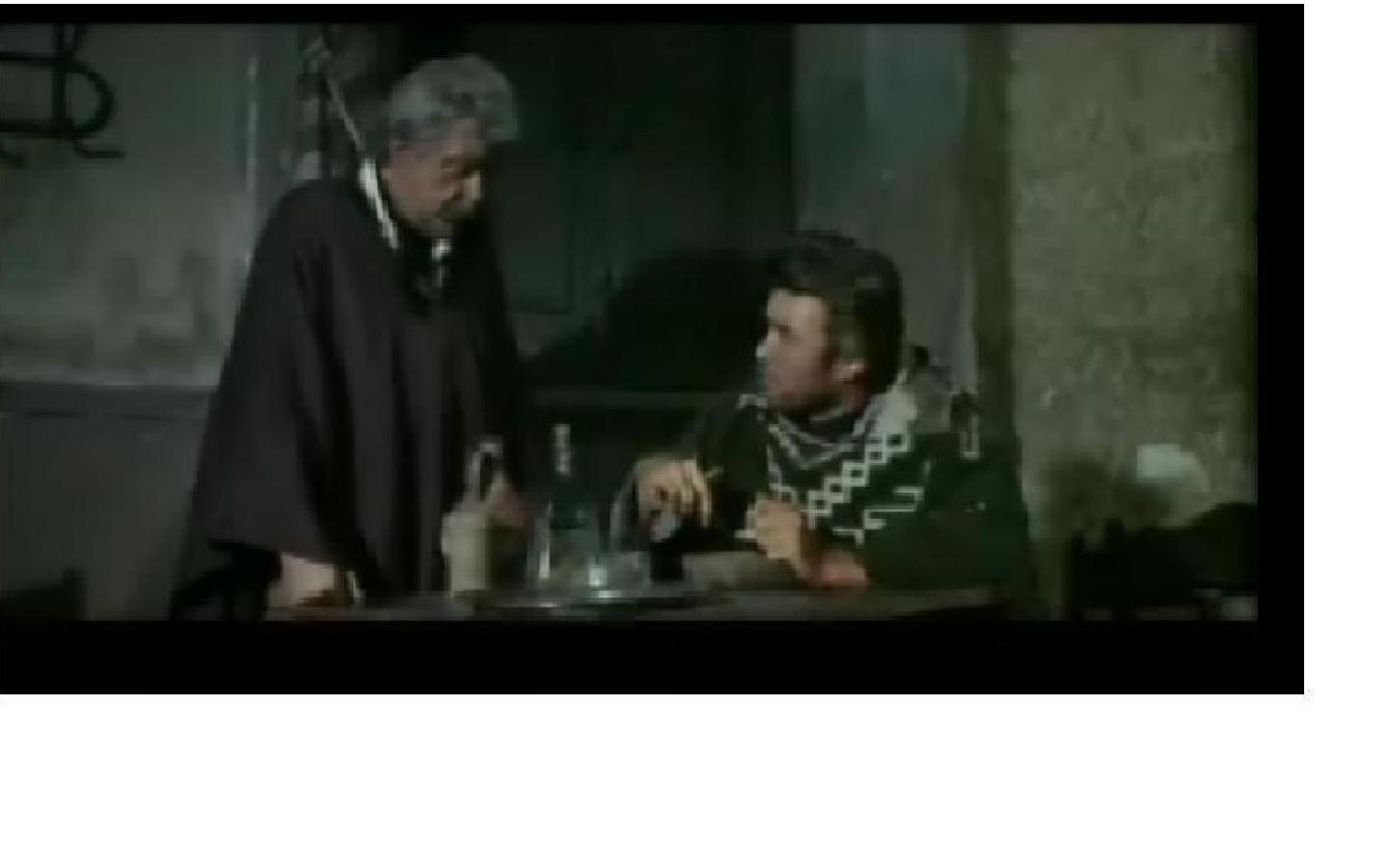
Sergio Leone’s self described “Fairytale for grown-ups,” A Fistful of Dollars is an intense look at a different kind of West than classically portrayed. Before the film even starts the viewer gets the idea that it is not like any other of the genre. The opening titles depicting silhouettes in deadly shoot-outs with Ennio Morricone’s ominous score, prepare the viewer for a redevelopment of the idea of the “Wild West” as perilous and violent, com-pared to more the romanticized depictions in classical Hollywood westerns.The title sequence sets the tone for the unromantized tale of savagery in a frontier soci-ety. Leone takes well-established conventions of the genre and turns them on their heads to demonstrate arguably a more realistic picture of the west and its inhabitants. The most obvious reworking of the genres conventions are the characters who are gritty, conniving, evil and constantly involved in power plays, scheming against each other. The lead character, the man with no name (Clint Eastwood,) is the best at this: able to exploit both sides in their struggle against the other, while stacking his money in secret. His anti-hero identity strongly contrasts traditional roles of benevolent protectors from films like Shane and High Noon, where the lead man rids the town of bad guys for moral reasons and asks for nothing in return.In A Fistful of Dollars, the dichotomy of good and evil is absent, both sides are evil and TMWNN eliminates both indiscriminately for one reason only: money.
The main charac-ters reflect the different values of character in Italian culture at the time, and also serve as a commentary on global issues. As Alberto Moravia states in his review on the film, cited in the article “Per Un Pugno Di Dollari,” by Christopher Frayling: “The main charac-ters are everyday delinquents who were in the background of American films but who, in Italian ones, have invaded the foreground to become the protagonists. The qualities which make them attractive, in the eyes of our public, are not generosity and chivalry but guile, street wisdom and ‘ingenuity’.” Leone’s characters are realistic; they are more identified with than the immaculate and virtuous protagonists that previously dominated the genre.

Other distinct differences that play down the romanticization of the west are the visual violence, bloodshed and grime. Leone was not shy about showing brutality between his characters. The amoral position of virtually every character, embodies a code of shoot first and don’t even bother asking questions; TMWNN dispatches four Baxter thugs right in front of their stronghold and when the Sheriff protests, he tells him to get the corpses in the ground. When the Rojo brothers firebomb the Baxter compound later in the film, they shoot every survivor as they come out despite their pleading surrender. One of the most shocking instances of violence is the interrogation of TMWNN by the Rojos. The scene shows Rojo goons beating the living daylights out of TMWNN with close ups on his bloody face and hand, to the delight of Esteban Rojo. The film is packed with these dramatic close ups that show in detail the bloody wounds, and dirty, sweating faces of the characters, these shots are worlds away from the single smudge of dirt and solitary rip in Gary Cooper’s shirt in High Noon. Leone’s characters are dirty from the beginning and become more and more tattered and filthy as the film goes on.

An interesting anecdote about the realistic grime of this film: the poncho the man with no name sports in all three of Leone’s trilogy was never washed throughout shooting of any of the films.
The aspect of the film that pulls everything together into the “fairytale for grown-ups,” is Leone’s heavily stylized aesthetic. Influenced by many classic western directors as well as the films of Akira Kurosawa, namely Yojimbo, which heavily influence the films plot and characters. Leone makes use of the widescreen format, favored by many Holly-wood western directors, not only to convey the enormous landscapes but to layer his mise-en-scène with extreme close ups in the foreground and other action in the back-ground.These shots are subtle but are everywhere in the film; in the hostage trade-off scene especially, every Rojo family member is shot using this technique. The use of these extreme close-ups, often of squinty eyes, supplements or replaces a lot of the film’s dialogue and adds the operatic suspense that became trademark Leone. The ex-treme close-ups convey much more than any dialogue could. Other distinct stylistic points are the quick zooms that bring us in to the extreme close-ups, imposing high and low-angle shots, gun point-of-view shots and parallel shots of different character.

In the final shoot-out between Ramon and TMWNN, Leone compares the two by first photographing each man’s dusty, spurred boots from low angles, then close-ups as each man loads his weapon and finally the extreme close-up on each man’s filthy face in a final stare down before TMWNN subdues Ramon. TMWNN is so fast on the draw the shoot-ing is done more by the gun than him, so shoot-outs are photographed from the gun’s point-of-view. These stylistic considerations give a personality to the film and build authentic suspense throughout.A Fistful of Dollars’ baroque take on the western sparked the massive wave of Italian “Spaghetti Westerns” that revitalized the genre in a dramatic but more realistic fashion. The era of quixotical Hollywood westerns was at an end, with the emergence of the wilder west.

_________________________________________________
Links
Archive of Leone’s films and other info about the director.
Samples Ennio Morricone’s score.
A fistful of Clint Eastwood.
Singing Cowboys.

_________________________________________________
Citations

Frayling, Christopher. "Per un pugno di dollari/ A fistful of dollars." The Cinema of Italy. Ed. Giorgio Bertellini. New York: wallflower, 2004.

Saturday, November 3, 2007

Suzy and the Twisted Technicolor Nightmare: Dario Argento's Suspiria

“Bad luck isn't brought by broken mirrors, but by broken minds.”
~Dr. Frank Mandel

From the opening frames of Dario Argento’s highly stylized nightmare Suspiria (1977) until the frenzied closing, the viewer is inundated with richly nuanced sub text and metaphor. Part of a trilogy told by Argento based upon Thomas de Quincey’s “opium dream” of three mothers in his novel Confessions of an English Opium-Eater, Suspiria tells the story of the wide-eyed, childlike Suzy Bannion (Jessica Harper) arriving for the first time at the prestigious ballet academy in Germany where she will be studying.

Down the Rabbit Hole...

Upon her arrival, a panic-stricken young woman is fleeing the building, and is soon thereafter murdered (in a uniquely Argentian baptism of gore). After Suzy begins settling into life at the academy, several strange occurrences including unexplained dizziness, hemorrhaging incidents during dance practice and additional murders complicate matters significantly for our poor, naïve protagonist. Suzy will go on to discover that the academy is in fact run by a coven of witches who plan to eradicate her, and she must summon her courage and overcome her innocence to defeat the head witch, the ancient Helene Marcos.

An Anti-Fairytale: The Maiden versus the Hag

The female archetypes portrayed in the film run the gamut. Our pure-as-the-driven-snow protagonist, Suzy, offers a counterpoint to the devious and malevolent women that populate the film, most notably the omnipresent and omnipotent Helene Marcos, who serves as the polar opposite to the goodness that Suzy represents. Like the “Hag” and “Maiden” archetypes of fairytale literature (Gould), Helene is the evil Queen to Suzy’s Snow White; we are not actually introduced to her until the very end of the film, and even then we are only allowed to see her in pieces. Ostensibly her visage is so horrifying we cannot be allowed to gaze upon it. Even Suzy’s fellow students, when they are introduced to her, are catty and cruel. Can Suzy ever really trust anyone?

Suzy, in Technicolor

Helene’s academy is inhabited by her coven of witches who do her bidding, and the most dominating presence in this vein is clearly the sadistic Miss Tanner; her thick German accent and severe presence evoke Nazi-era monsters such as Ilse Koch, dubbed “Buchenwälder Schlampe” (The Bitch of Buchenwald) by the inmates who suffered horrifically at her hands. Miss Tanner serves as one of several fascist elements in Suspiria. In her essay “The ‘Mother’ of All Horror Movies”, Linda Schulte-Sasse explains: “What was National Socialism if not a historical version of what the witches achieve on a seemingly apolitical level: a systematic reign of surveillance and paranoia, a disciplining of the body and social behaviour (those punished in Suspiria are the ones with a "strong will"), a process of selecting who belongs to the ‘we’ and elimination of who does not.”

A Blood-Splattered Space: Carol Clover’s “Terrible Place

The action of the film revolves entirely around the chilling dance academy, an absurdly stylized space that seems to defy logic almost as much as the film’s plot, characters and subject matter completely flout reason. We are ushered into experiencing the spaces of the film as such in the opening apartment scenes, when the fleeing girl and the woman are gruesomely murdered.

Killed by falling compass in a geometric nightmare

Everything about this space is ludicrously over the top. The architecture of the apartment, the vibrant, screaming color scheme and the almost slap-dash madness of the building’s layout; these elements all help prepare us for entry into the main event, the arena in which the essential action will take place: the dance academy. A bizarre charlatan of a building, bathed as it is in a violent red, the building seems torn directly from Argento’s own phantasmagorical imagination; however, it is in fact an actual location: Haus Zum Walfisch (Whale House) in Freiburg, Germany.

It is this space that echoes the idea set forth by Carol Clover in her essay, “Her Body, Himself” of the “Terrible Place” in the slasher film canon, the veritable fun house of horrors in which our protagonist will experience the most unspeakable of terrors, where she must face down and defeat the slayer or become yet another victim of the meat grinder. In Clover’s estimation, “The house or tunnel may at first seem a safe haven, but the same walls that promise to keep the killer out quickly become, once the killer penetrates them, the walls that hold the victim in.”

Bloody Red and Bruised Blue: Color in Suspiria

A phantasmagorical version of the NBC Peacock

Undoubtedly the most striking element at work in this film is the use of color. Color which at once saturates, overwhelms and assaults the audience, not a single shot is free of its heavily stylized use. Reds (the most prominent of the film’s colors) permeate the image to warn us of impending doom; softer lavender and blue hues steep the frames in their ominous glow. Indeed, it is the colors and the image that dominate this film, carrying the audience beyond the narrative. Schulte-Sasse explains that, “Throughout the film we are held captive by image and sound; each movement from space to space—whether the drive from the airport, a walk up or down the gilded school staircase, or a subjective traveling shot through the red Jugendstil corridor of the dance school—is experienced more aesthetically than in narrative terms.” (Schulte-Sasse) According to an un-credited source in the trivia section of the Suspiria page on www.imdb.com, the film was shot on standard film stock and printed using the outdated 3-strip Technicolor process on one of the few remaining machines to achieve the over-saturation of color.

Malicious Melodies: Goblin's Soundtrack

The film’s menacing score is provided by Argento-favorites Goblin, an Italian prog-rock band who also scored Argento’s Deep Red and George A. Romero’s horror classic Dawn of the Dead.

Their unnerving score perfectly compliments the ominous tone of this film, offering timely portents of danger. The music is heavily laden with frightening sound effects (screams, whispers, etc.) that add to the hysterical pace of the film.


While its highly stylized manner may alienate some, I believe it truly adds to this richly surrealistic nightmare of a film. Personally, I found Suspiria difficult to review, due to the overwhelming amount of symbolism and metaphor it contains and my desire to write many more pages. As a long-time fan of Profondo Rosso, I highly enjoyed this film, and I would certainly recommend it to both Argento fans and horror fans alike.

____________________________________________________________________

Suspiria at IMDB.com: http://imdb.com/title/tt0076786/

Suspiria at Wikipedia: http://en.wikipedia.org/wiki/Suspiria

Reviews at Rotten Tomatoes: http://www.rottentomatoes.com/m/1020662-suspiria/

Review at Slant Magazine: http://www.slantmagazine.com/film/film_review.asp?ID=405

Comprehensive site on the life and work of Dario Argento: http://www.darkdreams.org/

Goblin’s website: http://www.goblin.org/

____________________________________________________________________
Citations

Gould, Joan. Spinning Straw Into Gold: What Fairy Tales Reveal About the Transformations in a Woman’s Life. New York: Random House, 2005. http://www.amazon.com/gp/product/0812975456/ref=cm_cr_pr_product_top/103-1851940-0704664

Schulte-Sasse, Linda. “The ‘Mother’ of All Horror Movies.” Kinoeye. 10 June 2002. http://www.kinoeye.org/02/11/schultesasse11.php

Clover, Carol J. Men, Women and Chain Saws: Gender in the Modern Horror Film. Princeton, NJ: Princeton U.P., 1992.


Wednesday, October 24, 2007

Forced into Nothing in Primo Amore

“What’s the point of being here?” Sonia asks Vittorio when she gets the impression that he does not want to talk to her when they meet for the first time. This is the question I kept asking as I watched Primo Amore. In this film, Vittorio, a goldsmith, finds Sonia perfect in every way except for her body, so she starves herself to be the perfect body for him. I cannot see why Sonia would go through such torture for a man who never tells her he loves her nor does anything that can be construed as an act of love. Yes, he does ask her to move in with him into a place where they can see the Romeo and Juliet castles. But he is not the passionate Romeo compared to her self-sacrificing Juliet. When he tells her, “Don’t disappear,” the irony undercuts any romantic meaning as she is disappearing by starving herself to please him. In the final scene, he tells her that he will be nothing if she goes away. However, he utters this to her after he declares that she is nothing while she is naked with her head down.

Vittorio treats Sonia like gold not as something of high value but as a literal piece of gold, as an object, to be molded into weighing nothing. He first sees her as gold when he visits her while she is modeling for a night drawing class. The moles on her body remind him of the gold specs arising from the molten liquid.

He makes gold pieces that weigh nothing that he tries to force people into manufacturing. He believes that if he reduces Sonia into nothing then she will be something precious. Unfortunately for him, scraping Sonia away causes her to break down on several occasions either crying, fainting, or sneaking bites of onion imagining it as a piece of chicken. At her final breakdown in the restaurant, I cheered for her as she attacks the neglected fettuccine dish and steals bites from the kitchen exclaiming, “I want to eat whenever I want.”

Vittorio does not seem to desire her as a sexual being as she loses weight. However, the close-ups used in the sex scene reduce Sonia’s body into pieces of flesh suggesting that he desires her in this reductive state. Yet, as she continues to starve herself, she and Vittorio have reduced their physical intimacy to hugs and scant kisses. This makes them seem more like friends than lovers.

Garrone seems to be obsessed with framing Vittorio around straight lines. Vittorio lives in a prisonlike apartment building. He and Sonia walk often down a street lined with street lamps. They also frolic in the woods in the midst of barren trees with very smooth trunks, showing by analogy how Vittorio thinks that a woman should naturally be thin as a stick. These straight-lined images suggest that Vittorio is imprisoned in his straightforward thinking. He can only see what is in front of him.

In one scene, what is in front of him is a Sonia who is blurred (Vittorio is also blurry but not as much as Sonia). His blurriness coincides with his “pep-talk” to Sonia. He explains that he is not with the present Sonia who weighs 45 kilos (99 lbs) but with a future Sonia who will weigh 40 kilos (88 lbs). Sonia appears blurry to show the audience how she is reduced to nothing physically and to show how Vittorio does not consider her feelings.


The impact of that image makes me forget that Sonia had set this torture in motion. In a visually uninteresting full shot, a skinny woman walks by Sonia at the pool. Sonia looks at the woman and then at Vittorio who has his eyes on the book. The close-ups and the blurry images make me blame Sonia’s condition completely on Vittorio even though she made the decision to starve herself. These shots make her look trapped into being nothing. And I am trapped by the aesthetic beauty of these shots. Thus, I sympathize with her struggle to fulfill someone’s desire for beauty.

In the final scene, Vittorio says “Only what truly counts remains.” And I remain disconcerted by this film so much so that I have to go eat for Sonia.