Monday, February 15, 2010

La Notte

Michelangelo Antonioni’s 1961 film La notte is about an established author, Giovanni, and his wife Lidia in post war Milan. La notte has been a highly respected motion picture worldwide, receiving numerous awards including the Berlin International Film Festival “Golden Berlin Bear” award for best film and the highly respected David di Donatello award (similar to America’s Academy awards), given to Antonioni for best director.

La notte introduces its audience to Giovanni and Lidia as they visit an ailing friend in the hospital before making an appearance at Giovanni’s book signing party. This initial scene reveals the movie’s set-up including moments discomfort, separation, and unusual silence. Throughout the film, there are many occurrences where words or conversation would seem appropriate, and at times crucial. However, Antonioni includes these moments to strengthen the notion of despondency between the main characters. Lidia’s abrupt solo exit of the hospital room and the following scene of her alone, crying, and in pain due to Tommaso’s state of health are evidence of her own life, revealing the pain and isolation within her marriage.

Many times throughout the film deliberate silence and gazes are exploited to dramatize the visual happenings, leaving the audience employed to insert their own dialogue and emotion. Giovanni and the deranged patient, the fight Lidia witnesses, her walk through the city, and the awkward meeting of Valentina with Giovanni and Lidia with the male party guest, are times where words are replaced with gazes, stares, and contemplation. At times, silence is disturbed with natural noises of planes, sirens, a baby crying, and rockets.

This void the director depicts in the film is exemplified by Giovanni’s wife Lidia. She made a vow to love her husband but finds it increasingly difficult to respect him and his profession as his attention is constantly elsewhere. The depressing emptiness the audience feels, is also felt by Lidia. She leaves the book signing party unnoticed and wanders the city in hopes of some excitement or meaning. As she drifts through the city she comes across a clock, broken with motionless hands, a symbol of her stagnant marriage and the constant void she is longing to change, but may be too late.


The film’s climax occurs at Gherardini’s evening party. It seems as though Giovanni senses his wife’s distance. He flirts with the host’s daughter Valentina. She insists that he should reunite with his wife. Giovanni dismisses this claim by saying Lidia sent him to her. Lidia, from afar, sees them together but decides not to stop them as she knows her relationship with Giovanni is coming to an end. With lost hope Lidia tries to make the most of her evening. One of few scenes where Lidia smiles and is seen enjoying herself is when she receives attention from a male party guest and is approached, inviting her to dance. Later Valentina confronts Lidia about her actions that evening with Giovanni, yet Lidia interrupts, making a confession of her own to Valentina. Her marriage is not what it once was.

The last few moments unravels the overwhelming feeling throughout the film. Lidia reveals her nightclub thought to Giovanni that remained a mystery until this point. Throughout the whole film, Giovanni and Lidia lacked affection towards one another; their interactions usually consist of short conversations with abrupt subject changes, avoiding argument and confrontation. Lidia expresses that the love she once felt has been exhausted. She made a choice to love Giovanni over Tommaso, but her love has extinguished.

The ending scene of Lidia and Giovanni together brings about a mix of emotions. The live band on Gherardini’s lawn sets the melancholy mood. When Lidia reads the love letter she pulls from her purse to Giovanni, he feels uncomfortable and queries who wrote such words of affection and devotion to Lidia. After he questions the letter’s author, Lidia turns to him in astonishment. “You did” she replies to Giovanni. His failure to remember his own words reassured Lidia that his professed love did not exist.

La notte may have left some empty, cold, angry, or sympathetic. The lack of words in the film is made up in emotion we feel for the characters. Director Antonioni embraces the fact that we are what we make of ourselves. For Giovanni his addiction wasn’t from “tasting the wine and becoming an alcoholic”(as he talks to Signora Resy), but can be metaphorically applied to his intellectual stature, success, and attention that blinded him from the love he had for Lidia.

Aside from the interesting voyage we took following the course of Lidia and Giovanni, I particularly found Antonioni’s cinematography visually pleasing as artist. Antonioni marvels his audience with his artistic expression in his cinematic creations. The director’s first name may be coincidental to one of Italy’s most celebrated painters and sculptors of the fifteenth and sixteenth century, but Antonioni doesn’t disappoint in his modern artistic expression of art using actors and motion picture as paint for his canvas. Antonioni may give the audience of La notte an additional reason to watch just for his stunning cinematography capturing Italy’s post war beauty. La notte is sprinkled with busy cityscapes, serene landscapes, vivid reflections, natural use of light, and extreme tonal contrasts to add an additional element of uniqueness. Antonioni’s attention to artistic beauty is just one of many aspects the audience of La notte will witness throughout the movie.

Here are a few sites that offer great additional information on the film and the director Michelangelo Antonioni:

http://www.culturecourt.com/F/Antonioni/LaNotte.htm
(Themes in the film La notte)
http://www.imdb.com/title/tt0054130/
(Reviews on the film)
http://archive.sensesofcinema.com/contents/directors/02/antonioni.html
(Biography of Antonioni)
http://mikegrost.com/antonion.htm
(Overview of Antonioni and his films)

Friday, February 5, 2010

Le chiavi di casa


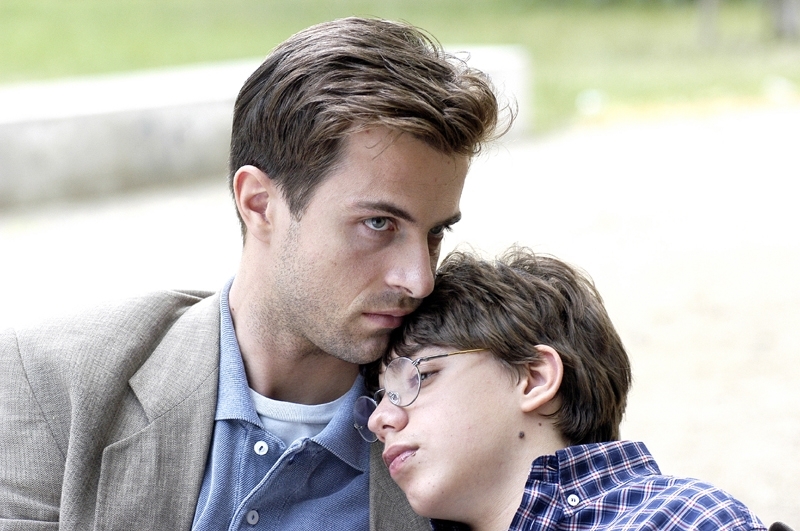
The 2004 film directed by Gianni Amelio Le chiavi di casa (The Keys to the House) is a very emotional film that deals with illness, family values, and unconditional love. It is a story that any human being can appreciate, no matter where you come from. It is a story of a man who, for the first time in his life, is meeting his fifteen year old son. What sets this story apart from the rest is this man, whose name is Gianni, not only has a fifteen year old son that he has never met, but his son is handicapped with muscular dystrophy. Seeing their relationship develop in the 105 minutes in which the film takes place is very touching to watch. You see these two strangers get to know each other over the course of a short period of time, and you get to see the love they begin to have for one another. Watching them onscreen together is something that touched me. The way that Gianni would look at his son was so full of raw emotion. You could tell as an audience member that he knew he missed a lot of things in Paolo’s life, and he didn’t want to miss anything else ever again. The conversations they have are never ones of importance (they talk about really general things), but even though the topics were not that important, the way they talked to each other was. They were getting to know each other, and it was very emotional to see them do that throughout the film.

This is also a story of forgiveness. When his son was born, Gianni walked out on him. The boy’s mother dies giving birth to him, and when Gianni learns that not only is the mother dead but the child will have many complications for the rest of his life, he immediately flees. He doesn’t even look at his son before he abandons him. The handicapped child, whose name is Paolo, is raised by his aunt and uncle. He never actually meets his real father until now. When this was all told in the beginning of the story, I wanted to hate the character of Gianni. How can somebody be such a coward and leave their newborn son like that? But as time went on, you can’t help but like Gianni. I wanted him to do well, I wanted him and his son to bond, and I wanted him to become a real father to this wonderful child. Andrea Rossi, the actor who plays Paolo, actually has muscular dystrophy in real life. Watching him on the screen was amazing. He was brilliant in this role, and actually having to live with this disease throughout his whole life made it all that more real and moving. The way these two people interact was something you could not look away from.

Another important character in this film was that of Nicole, played by Charlotte Rampling. She was someone that Gianni met in the hospital, and she too has a mentally and physically handicapped child named Nadine. She and Gianni become fast friends, and she teaches him so much about life and the struggles that are apart of it. She never ran away from her responsibilities as a mother, but she also doesn’t fault Gianni for running away from his. She gives him hope, and she ultimately makes him want to become a better person, for himself and for his son.

In conclusion, this film really spoke to me. Having members of my family that are handicapped (although not as severely as the children in this film), it is nice to see a film about handicapped people without one mean or negative thing said about them. Gianni isn’t afraid anymore of what he must do for his son. He just doesn’t want to see his own flesh and blood in any more pain. (There is even a scene in the film where Paolo is in the hospital getting his blood taken, and Gianni has to leave the room). He knows he is new to all of this, but he is willing to do whatever it takes to be there for his child. This is essentially a love story, but not between two adult people, but between and man and the son he never knew. It is a beautiful film.


I also looked online to see what other people thought of the film. It was interesting to see their reactions to it. Here are a few links I found that had some opinions of the film.

movie review of the film

rotten tomatoes review of the film


Tuesday, February 2, 2010

Le Fate Ignoranti

A movie full of confusion, scandalizing events, and broken hearts, Le Fate Ignoranti (2001) won awards at a number of Gay and Lesbian Film Festivals such as; ‘Best Film’ at the New York Gay and Lesbian Film Festival and ‘Best Film’ at the Austin Gay and Lesbian International Film Festival. Ferzan Özpetek, the director, is of Turkish descent but resides in Italy. He is an openly gay director who deals with numerous sexual issues in several of his films, including this feature film and also La finestra di fronte (2003).

This movie begins as Antonia strolls around an art gallery, anxiously awaiting her husband. A man eventually approaches her and at first seems to be a complete stranger: she blows him off. Shortly after it becomes evident that this stranger is in fact her husband Massimo, and Antonia was ignoring him because of his late arrival. This opening scene offsets the movie right away; it gives us the idea that their relationship was a bit strange, due to meeting at an art gallery and him arriving reasonably late.

In early scenes of the movie we discover a typical relationship between the two spouses, yet they seem to be a bit distant: he departs frequently for business trips and soccer games. One day when Massimo was leaving for an entire day to go watch a soccer game with his friends, he was crossing a busy road and an SMS message distracted him. While grabbing for the phone, in the midst of crossing the road, a car struck him and he was viciously whipped in the air and died on impact.


A newly developed scene arises and it seems as if a couple of weeks have passed by, due to Antonia clearing through all of Massimo’s things. While scavenging through his belongings she finds a large painting that seemed to be a present someone had given Massimo. She reaches for the painting and discovers that there was a hidden message on the back from what seemed to be a mistress of some sort. It was signed, ‘La tua fata ignorante’ (your ignorant fairy)

With Massimo deceased, Antonia is devastated to have found out that he was probably having an affair with this mystery person for who knows how long. She goes off and tries to discover this mistress and does her best with the leads she has. She stumbles upon an apartment complex and finds a group of individuals that seem to be a bit different; due to hair style and the way they dress. Antonia asks to see if she can possibly speak to a certain lady (she found out the name of the person who sent Massimo the painting) but the individuals who live there say that she is gone and isn’t coming back for a while. This seems to intrigue Antonia and she comes back frequently to see if she can possibly encounter this mistress or possibly pick up more evidence.

On her frequent visits she becomes close to all these individuals of the apartment complex because they seem to brighten her spirits. They are always together, compared to her being at her house virtually alone. It eventually becomes evident that this group of friends forms a community that involves many different categories of people; homosexuals, transsexuals, and even heterosexual immigrants. Antonia isn’t bothered at all by this because they were always very friendly and open hearted. Quickly after Antonia discovers who the mistress of her husband actually is, turns out it was actually the most kind of all the people at the apartment complex, a man by the name of Michele. Massimo was cheating on Antonia with a gay man for 7 years. This basically tore Antonia to pieces, but due to her being very close to this new group of friends, Antonia seems curious to discover what Michele and his world has to offer.


The rest of the film is an adventure to see what this Michele was all about. Antonia was frequently with this homosexual ‘mistress’ and they became very good friends, almost too close.

It was in a book store while searching for a book, a collection of poetry by Nazim Hikmet, upon finding the book, Massimo approached him and offered practically anything for it. Michele explained that he was shocked because he never met anyone that liked the same poet as himself. The scene develops with Antonia figuring out exactly what book he was talking about. She then proceeds to recite some verses by the author, that of which Massimo knew. Michele asked Antonia if she and Massimo would recite Hikmet with each other often. She told him that Massimo had no idea who Hikmet even was; the book was for her.


Another interesting scene is when Michele was upset with himself for having an affair with Massimo all these years. Antonia and Michele, both moved, experienced an emotional connection which for a moment became a romantic connection, as they leaned and in to kiss one another. Antonia was being sexual with the homosexual man that her deceased husband was having an affair with for 7 years.
These scenes tied everything together for me. It seems as if the two were actually perfect for each other. Massimo found similar qualities in Antonia and Michele so therefore it led him to having a relationship with both of them. So when Antonia and Michele actually got to know each other they quickly began liking each other more and more, probably because they are more compatible with each other than Massimo was with either of them.

I personally found this film to be a bit strange, very out there. It is a movie that needs to be viewed more than once to appreciate its true value. It’s a story of love, a strange kind of love, a love that is never truly fulfilled. I viewed Massimo as being almost a middleman in the perfect relationship; he had a relationship with two individuals that were more perfect for each other. Massimo was one that would be able to please two different people very well, but he did it in a very mysterious fashion. His actions were probably due to him not being able to connect extremely well with the two so he had to get the best of both worlds, little bits at a time. When Massimo was out of the picture an amazing chemistry developed between Antonia and Michele. Something was there that I truly believe Massimo didn’t have with either of the two.

http://www.rottentomatoes.com/m/his_secret_life/

I thought that the American trailer of the film was pretty interesting to watch due to the very sexual vibe you get from watching it. Even though the film itself wasn't very sexual.

This Italian trailer makes a lot more sense. The film itself was presented a lot better and clearly in this trailer. The different reading of the movie from watching two different trailers to me is quite interesting.

Monday, December 17, 2007

The Hundred Steps


The Hundred Steps is a historical film, depicting the life of Peppino Impastato, outspoken activist against the Mafia. The film is a terrific look into a significant time period in the history of Italy.


HISTORY
Researching Italian history, I am amazed to find how deeply the idea of communism is rooted in Italy. For a country so slow to industrialize, Italy has taken vast steps towards the left. It began with the Partito Socialista Italiano, PSI, or Italian Socialist Party in 1892. This party at its height was 860 thousand members strong in 1946, according to Wikipedia. This party eventually split into two separate groups: the reformists- who were strong in parliament, and the maximalists- led by Mussolini. Soon the Maximalist group overcame the reformists and ousted them from the party. Developed through leftist views came the Partito Comunista Italiano, PCI, or Italian Communist party, a group that reached higher prevalence than the socialist group with over 2 million members in 1947. The group was once led by Antonio Bordiga and Antonio Gramsci as they increased the rift between their party and the socialists.


TERRORISM
The Red Brigades was a terrorist group active during the “Years of Lead” or highly turbulent time of political instability. There were many politically-motivated murders, one being the killing of Aldo Moro, who was assassinated during this time. Moro, a Christian Democrat, was trying to make compromises with the Communist party, led by Enrico Berlinguer, an agreement known as the compromesso storico, or historic compromise. In an extremist response, the Red Brigades kidnapped Moro and after 54 days of captivity, assassinated him. The terrorist group left the body in the trunk of the car half way between the Christian Democratic office and Communist offices in a symbolic gesture. Today there are also many different conspiracy theories concerning the death of Moro.


The actions of the Red Brigade show some significant resemblance to the FLQ, or Front de libération du Québec (Quebec Liberation Front). The FLQ was another terrorist group that used extreme means instead of peaceful endeavors. Like the Red Brigades, the FLQ was comprised of Marxist followers who wanted to declare war on their Anglophone oppressors, overthrow Quebec government, and separate from Canada. The group was active from the years 1963-1970, and was responsible for over 200 bombings and the death of five people. Two separate FLQ cells kidnapped two political figures, one after the other. First it was English-speaking James Cross, British Trade Commissioner, and than Pierre Laporte, Quebec’s own Minister of Labour. Laporte was soon killed (some reports suggest it was an accident). In order for Cross to be released they made several demands, including transportation to Cuba. Some of them were met and after two months, and Cross was finally let go. This period was known as the October Crisis.

This terror organization seemed to operate much like the Red Brigades, or least performed some acts that are closely similar. These actions took place less than a decade before, and proved to be successful on some account. The actions of this group could have likely inspired the Red Brigade’s kidnapping of Aldo Moro.


CINEMA

Color. The mise-en-scene in the film is very detailed. The use of the color red is abundant throughout the movie. For instance in the scene where the young Peppino is at his Uncle’s funeral, his small frame is surrounded (?) by an extravagant red thrown like chaird looking like the king of Communism (if there could be one). Also in the scene after his father first learns of his dealings with Communism, there is a red light covering him while he is lying on the bed, showing that this ideal of Communism was soon to encompass his life.

Music. There was also a significant amount of American music used in the film. In fact in scenes that show Peppino in progress, mostly have an American soundtrack in the background. I found this extremely peculiar, since for most American, the ideal of communism is taboo. II Iasldkfjfjdkls;a jlkewr Although the soundtrack featured artists synonymous with the anti-war, leftist view, like Janis Joplin and Lenard Cohen. I was also surprised to see how the hippie culture was vastly apparent in Italy during that time.

STORY
The story is one that is bittersweet. The reality of it even seems to contain dramatic, narrative elements. The way in which Peppino was killed mirrored the same way that his Uncle, whom he had a positive relationship with, was killed. There is also the probability they along with Peppino’s father were set up to be killed by the same person, Don Tano. Tano, who lived just one hundred steps away, was an interesting figure. In the 80’s he came to the U.S. and sold drugs out of pizza parlor. He was convicted in 1987 for drug trafficking and then later in 2002, was convicted of the death of Peppino Impastato. Tano died in prison. His drug empire was estimated at $1.65 billion.

A complex version of Tano exists in the film. In the scene where he visits Peppino at the coffee house we see a side to Tano that we have not previously encountered. You see the struggle inside of Peppino as Tano explains what he has done for his family. In a sense, Tano helping Peppino’s father, actually helped Peppino become what he was. Peppino’s family wasn’t suffering from financial peril and this allowed him and his brother to attend school. Is the scene in the pizza parlor a dream sequence, or did Tano really offer an escape path to Peppino?

It is very ironic that the Impastato business was a pizza parlor, which was also the means that Tano used to sell drugs in the states.
http://news.bbc.co.uk/1/hi/world/americas/3675535.stm


http://www.youtube.com/watch?v=xnDEcQm5lEE&feature=related


http://www.youtube.com/watch?v=Gq7ekpUjrMs&feature=related

Thursday, December 13, 2007

L'America

"While he has not made a documentary, his film reflects a heightened sense of reality derived from the experience of life." --- Rob Edelman

“L’america” was directed by Gianni Amelio (the man responsible for a film we watched earlier in the semester, “The Keys to the House”) and released in 1994. What is unique about this film is that it brings traditional linear Italian film-making to new places by using the methods of neo-realism to carry the audience along on a dreamlike, ironic mythologizing journey whose mood and methods are all his own. This extremely powerful film, almost documentary-like in its presentation of its characters and themes, is as fantastic as it is vividly concrete and sad.

The film tells the story of two Italians, Fiore (Michele Placido) and his assistant Gino (Enrico Lo Verso) who go to the impoverished, wrecked post-communist Albania with the scam of setting up a shell shoe factory as what they - or Fiore, for the most part, because he by himself is the mastermind of the scam - think will be a profitable tax shelter. They corrupt an Albanian official named Kruja, which they turn into Croce (cross) to grease the bureaucratic wheels and obtain government approval for the plan. Unsatisfied with others who have cooperating families who are able to make claims, they find Spiro (Carmelo Di Mazzarelli), an old man they are told is an orphan and has been imprisoned by the communists for fifty years. They sign him up as the Albanian figurehead "president" of the company. Fiore hurries back to Italy and leaves Gino in charge of watching over the derelict factory they have taken control of, and also to make sure Spiro stays out of trouble.

When Fiore leaves however, things go wrong, and as the story progresses, they get even worse, until Gino has lost everything - even his Italian identity. The journey we as the viewers go on is compulsive watching and echoes tragic wanderings like those of the father and son in De Sica's “The Bicycle Thief”, or the couple in Fellini's “La Strada.” Amelio achieves a sense of understanding and a sorrow and pity that a person can have only when everything has been stripped away from them and nothing but their essential humanity remains. Basically, you have to imagine the worst thing that could happen to you while on a journey, and then take that even further, and you have an idea of the trajectory and transformative emotional power of “L’america.”

When Gino finally gets ahold of Fiore on the phone, he learns that their scam has failed, and they are not only in deep trouble, but he and Spiro are both out of a job. Of course, Spiro says he knew this would happen all along. The Spiro character is extremely pivotal in the film. At first he appears as a derelict, worse than a bum, clearly out of his mind. When asked his age he holds up his fingers twice, and the viewer realizes he still thinks he’s twenty years old. But somehow there is a young man still inside Spiro that seems to emerge as the film goes along as a figure of great humanity, energy and hope.

The first disaster occurs when Spiro disappears from the nuns' institution where they have left him. After being a prisoner for fifty years, all he wants to do now is escape. Gino finds him and takes him on a journey along the coast in a jeep, but once they're out in the middle of nowhere, Gino is lost. He runs around frantically looking for Spiro, and when he gets back to the car, it has been stripped of its tires. He calls for the police, but since he only speaks Italian, no one can understand him. They can only stare at him. These faces Amelio shows us, and again at the end, in that powerful closing montage on the boat heading for Italy at long last, communicate more with these pained and tired expressions than any words ever could.

Much like the great Italian neo-realist filmmakers of the forties and fifties, Amelio uses real places and real people with great skill. What does all this mean? First of all, it's an affirmation of the sheer and inexplicable power of poverty. The fact that Spiro's insanity comes across as beautiful and hopeful shows that the film is not to be taken too literally. The film shows us a lot about Albania, colonialism, rich and poor nations and economic exploitation, yet at its core it is truly a film of heart-wrenching sadness. When we see those faces in the closing scene, the pain felt by these people is truly individualized, showing us the viewers that the problems highlighted not only in this film but in other issues plaguing the world today can be seen in one agonizing stare.

“L’america” is a breathtaking film, and clearly sets Amelio apart as one of the most powerful and humanistic Italian filmmakers working today.

Source:

http://www.filmreference.com/Films-A-An/L-America.html

Wednesday, December 12, 2007

I Cento Passi

I Cento Passi

“I want to give up politics and life” – Giuseppe “Peppino” Impastato

This was the sentence that allowed the city officials in Cinisi to pass off Peppino’s death as a suicide. In reality the mafia dealt him out a fate he and his supporters probably could have seen coming, considering he spent the most important years of his life mocking them and their ill power.
The film I Cento Passi directed by Marco Tullio Giordana serves to recount the tale of Peppino’s life from his childhood to his unfortunate death and even beyond, to show his numerous supporters. This fast-paced film brings out Peppino as a people’s hero, sacrificing his safety and eventually his life to expose the government and mafia for what they really are. Peppino’s views on how the government should function and his radical ideas of Socialism thread through the film a story of a countercultural struggle against the people who have the power and refuse to give it up.
The opening of this ‘anti-mafia’ film is oddly similar to most mafia films that glorify the mafia code. The slow pacing and long shots certainly intensify the tension of the film. It takes young Peppino to a celebration where he becomes attached to his uncle Cesare Manzella, and also seems to be a young predecessor that might carry on the family’s name. We are introduced to Tano, who is the antagonist to not only this film, but also Peppino’s true life, when Peppino almost runs him over while trying to learn how to drive. Just like most mafia films the villain is introduced early and now all the audience is waiting for is someone to get whacked. It comes when Cesare is blown up in a car bomb, something that the audience can see from a mile away.
The oddest thing about this set of events is that in essence, they are all true. All of the events have probably been embellished a little, just to dramatically heighten the action, but all of the family relationships existed; Tano blew up Peppino’s uncle Cesare in the tragic car bomb fashion; and after Cesare’s death pieces of his body were found clinging in lemon trees meters away from where the explosion occurred.
After Cesare’s funeral the film takes a change of course and turns from looking like a mafia film into an anti-mafia film. The foreshadowing begins when young Peppino is sitting in a deep red chair at the funeral, away from the rest of his family. He is observing the rituals of the mafia and looking very critical of their actions. Subsequently the editing quickens its pace, showing us action and reaction shots that relay information as fast as the audience can process it. After the funeral Peppino visits the artist Stefano whom he heard speaking in public days before and asks him to paint a portrait of his late uncle Cesare. Stefano refuses and instead tells Peppino a story and a poem that will alter Peppino’s life forever. With the foreshadowing of red drapes flowing behind young Peppino, the film then thrusts us years later when Peppino is actively protesting with his Socialist group. The group is storming the police and a throwing themselves in front of a group of bulldozers that are trying to develop the land. The two lifestyles are juxtaposed wonderfully to start a parallel of politics between the two factions of the counterculture and the power holders.
The development of the mafia and mob bosses has probably existed a long time, and has been a group that has focused on the importance of deep politics. Sadly, the passive-aggressive way in which the mafia seems to get things done is by committing criminal acts such as murder in order to get what they want. In the opening scenes of I Cento Passi, there are many references to the changing times in Italy. A group of kids joke around when they are near a car asking where the horses went, and when the Socialist Stefano is speaking out against the dangers of the mafia, Cesare tells him the new wave of politics in Italy is a democracy, and people are getting more jobs and making ends meet. There irony in this statement because while technology is advancing, the common people are not experiencing any relief from the suffering. The economic miracle is simply only giving more food and power to the mafia. Certainly, the mafia would look forward to a capitalist society because in all ways that is how a mafia functions. They are very much a pro-bureaucracy group, with one person functioning as the head and many individual levels of bosses below that. It is this fundamentalism that helps fuel the mafia’s distaste for Communist believers. Politically these groups are far left, and far right, and the state of the society surrounding Peppino is clearly far right. At one point Peppino’s own father says he will kill him if he is truly a communist. Marxist followers focus on the rise of the lower class and the dissolving of classes that hold power in society. This power will fall into the hands of the people and an eternal utopia will form.
Peppino’s course of action through the film is to try and inform people using a deep mixture of media and culture. Italy is famous for its contributions to art and literature, and both will become devices which Peppino can use to deliver his message. When Peppino founds the radio station Radio Aut, he begins to broadcast daily messages to the people, poking fun at the mafia and similar institutions. This young, fast-paced generation seems to try and do anything to capture the attention of the people to inform them of the corrupt ways that need to change. The soundtrack to this Italian film that accompanies the radio station and Peppino as he travels around Cinisi is primarily an English one that has a lot of American counterculture rock bands. The sounds of Janice Joplin and Leonard Cohen help provide an atmospheric background to Peppino’s political crusade.
When his lack of fear for the mafia finally thrusts Peppino into the position where he believes he has enough supporters to start an actual political campaign, the tide turns for him. In the Sicilian town Peppino consults Stefano to get his input on the idea of him running for office under the Socialist Democratic party, and once he has announced he is going to run, the mafia steps in. They handle Peppino much like they are expected to, only in a much more gruesome manner. The kill Peppino and blow his body up so that there is no trace of him left.
The fact that the officials would try and hide his death as a suicide proves despite the adoration and agreement Peppino’s supporters had for him, it did not equate to years of power the mafia held. It is appalling that the government has kept the case closed on Peppino, and waited twenty years to take action against Peppino’s killers.
Considering the current political climate, this film is a very potent one. It is important for citizens, especially in a democracy, to know what is going on in the government. While Peppino’s ideas of government may not be a completely achievable goal, the freedoms he spoke out for, especially freedom of speech, are important to society. Had this film not documented Peppino’s account, many people would not know the lengths to which one man went to fight for what he believed, and I am curious to know what Peppino’s thoughts on the current state of the world’s politics would be had he not been brutally murdered thirty years ago.

Sources:

Ruberto, Laura E. and Kristi M. Wilson, eds. Italian Neorealism and Global Cinema.
Detroit. Wayne State University Press, 2007.

Sunday, November 18, 2007

Francesco Rosi’s The Truce (1997)

Francesco Rosi’s adaptation of Primo Levi’s 1963 novel La tregua (The Reawakening in the USA) deserves to be acknowledged for some important merits. First of all, Rosi took the responsibility to film the difficult work of an established and widely known Italian author. Secondly, he choose to adapt one of Levi’s books that is surely less famous than the survival account Se questo è un uomo (1947 and 1958, If This Is A Man) and in doing so, he decides to show a less explored topic related to the Holocaust: the survivors’ return at the end of the war. Thirdly, in retelling us the story of Primo Levi’s return from Auschwitz, Rosi increases the short list of Italian films about the Holocaust, a list that in 1997 counted only Kapò (1959) by Gillo Pontecorvo, Il giardino dei Finzi-Contini (1970) by Vittorio De Sica, Pasqualino Settebellezze (1975) by Lina Wertmüller, and Jona che visse nella balena (1993) by Roberto Faenza. However, Francesco Rosi’s film, even considering the difficulties of approaching the Holocaust theme and the adaptation of a book highlighted by Milicent Marcus in her “Francesco Rosi’s The Truce,” fails to be compelling and to allow the viewers to become, as Marcus says, the “addressable others” (267). This failure is caused, in my opinion, by the excess of explanatory and didactic dialogues, especially in the second half of the movie. The film says too much with words instead of suggesting with images, and this is even more jarring when the words come from Primo Levi, a survivor who felt the burden of guilt for having escaped death and who wrote poetry and pages of an extreme symbolic power. When Rosi’s film ends, the viewer has the impression of having witnessed/observed a compilation of Holocaust topoi: the feeling of guilt of the survivor, the problem of Jewish camp collaborators, the role and the place of God during the time of the Shoah, the survivor’s responsibilities to let the world know, and the prisoners’ anguish for their families’ fates—all of this, but without having room to think about them, or, using Levi’s words, to meditate.

The opening establishing shots

The film starts with eloquent captions that set the time and the place: Auschwitz, January 1946. In addition, the fire, the German shouting, and the barking dogs contribute to recreate a “familiar” Holocaust scene. After few minutes, though, Rosi decides to show us Primo’s tattooed arm with a close-up, as to re-center our attention to the protagonist of the story and away from the mass of prisoners running away from the Russian army. The symbolic power of the tattooed number allows us to read this image as an unusual establishing shot that contributes to our attitude toward the movie.

The same shot will be repeated at the end of the film. Primo is back home and he is about to start writing Se questo è un uomo. His survivor’s status is now full of responsibility: he is now a messenger and the number on his arm is there to remind him of his new duty.

Disorientation

The following scenes show the beginning of the long journey home. As in other films and literary works about the Holocaust, confusion and disorientation are the common feelings among the prisoners. Although apparently calm and serene (a state that Turturro’s Levi seems to be very comfortable with), Primo shares the same sensation as the repeated questions he poses in the first hour of the film testimony: “Go where?,” “Kept by whom?,” and “Where are we going?” This disorientation, however, does not coincide with the filming of the journey. The viewer is never lost and the journey, although winding, appears linear.

Rosi’s translation

As observed by Marcus in her article, Rosi takes the responsibility to be Levi’s translator and messenger in the market scene. In this scene, Primo tries to tell what living at Auschwitz was to the people at the market. Initially, he has the help of a person who is able to translate in Polish what Primo tries to say to sell his shirt. However, as soon as Primo starts talking about Auschwitz, the translator refuses to continue. Rosi, then, with the movement of the camera that pans until arriving on top of the people, makes the viewers aware of his presence and accepts the task of continuing Primo’s testimony.

Rosi’s “Cinema of Prose”

In fulfilling his duty of messenger of a messenger, as said before, Rosi is very assertive and didactic. In the second half of the film, in fact, in a series of short scenes, many issues related to the Holocaust are treated and apparently exhausted in a very simplistic way. Among these, I will talk about the problems of the camp collaborationists and of the German feeling of guilt as they are treated in two scenes of the film. The first issue is quickly approached when Cesare is distributing the meat of a calf and Daniele (a character who is never fully developed) prohibits Flora from having it because she “broke bread with the S.S.” Primo’s opposition to Daniele is clear and understandable. Nonetheless, the problem of Jewish collaboration with the Nazi deserved a much deeper analysis than the acceptance/refusal dichotomy and should have not been liquidated in terms of right or wrong.

The second issue is focused in particular in the Munich station scene. Although Marcus’ analysis of this scene highlights interesting connections for the image of the kneeling German, I still feel that Rosi’s choice does not pay enough attention to the extent of controversial historical and sociological knot. This image is much too conclusive to be credible, especially considering the historical context of 1946.

Rosi’s “Cinema of Poetry”

A scene that could be qualified as a moment of Pasolinian Cinema of Poetry is the scene in which the Italian survivors watch through a window the Russian family who gave them food to eat. Uncertain about their journey and about the fate of their own families, in this scene through the deforming glasses of a window this family appears like an unreachable mirage. The deformation and the color of these images tell us about the feelings and desires of these Italian men much more than they could explain with words by themselves.

In my view, if Rosi could have adopted consistently these stylistic choices, he would have realized a much more compelling movie that would have pushed the viewers to think about the survivors’ journey more than just consider it a mere act of tribute.

Links:

An article about Primo Levi’s death/suicide

A web site about Primo Levi’s literary works

Resnais’ poetic documentary about the Holocaust Nuit et Bruillard (1955, in French with English subtitles)

A page and a video about Willy Brandt kneeling in 1970

Citation:

Marcus, Millicent. “Francesco Rosi’s The Truce.” After Fellini: National Cinema in the Postmodern Age. Baltimore: Johns Hopkins UP, 2002.